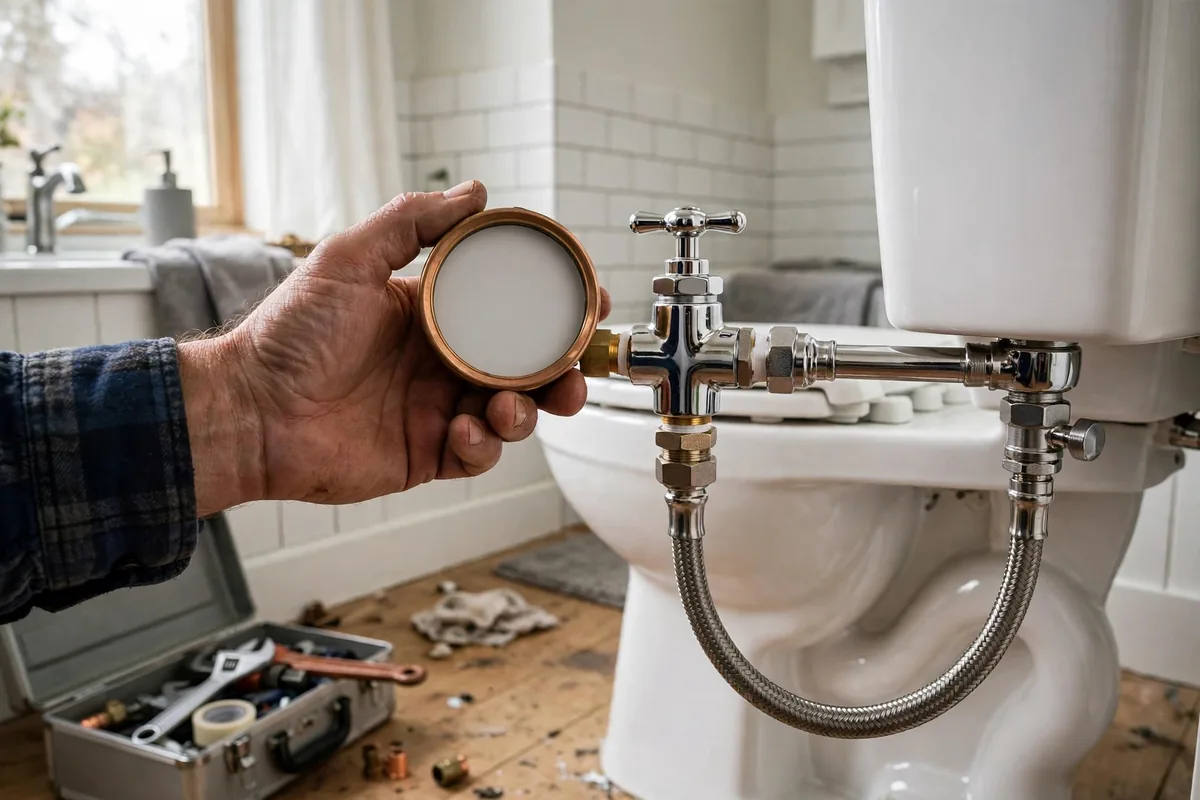
TL;DR
Problem: As the toilet finishes refilling, there is a bang, a thud, or a shudder in the wall — sometimes once, sometimes a short burst — and then silence until the next flush.
Solution: That is water hammer: the pressure wave created when the fill valve closes quickly and fast-moving water stops dead. Whether it is a toilet problem or a house problem depends on whether other fixtures do it too. Fixes range from a fill valve change to a pressure check and a hammer arrester — all after the timing test below.
When to call: If the bang is new and loud, shakes pipes, or other fixtures do it too. Call (714) 410-0362 during open hours.
In this guide
Pinpoint when the sound happens
Toilet noises are diagnosed by timing more than by volume, and this one has a signature moment: the bang lands at the exact instant the refill stops — not while the tank is filling, not during the flush itself, but in the half-second when the fill valve closes and the rising hiss cuts off. One solid thud is typical; a quick machine-gun burst of three or four smaller knocks is the same event bouncing in a longer pipe run.
Two other sounds get confused with it, and the timing separates them. A whistle or hum during the refill is a fill valve straining — a different problem, covered by the same valve but a different fix. A gurgle as the bowl drains is the drain and vent side of the system, not the supply side at all — our gurgling guide covers that family. If your noise is a bang at shut-off, read on: you are in water hammer territory.
What water hammer actually is
Water moving through a pipe has momentum. While the tank refills, a column of water is travelling through the supply line at speed. When the fill valve closes — and modern fill valves close fast, which is normally a virtue — that column has to stop instantly. It cannot compress, so its energy converts into a pressure spike that races back down the pipe, hits the next elbow or valve, and bounces. The bang you hear is the pipe flexing and knocking against whatever it touches — a joist, a stud, the inside of the wall — as the spike passes.
Three things decide how violent it is: how fast the water was moving, how abruptly the valve closes, and how high the home's standing water pressure already is. That third factor is why water hammer often appears in a house that "never had it before": pressure from the street varies, pressure-reducing valves age and drift, and a system that was just below the banging threshold crosses it. The toilet is simply the fixture that reports it first, because it refills on its own, at quiet moments, several times a day.
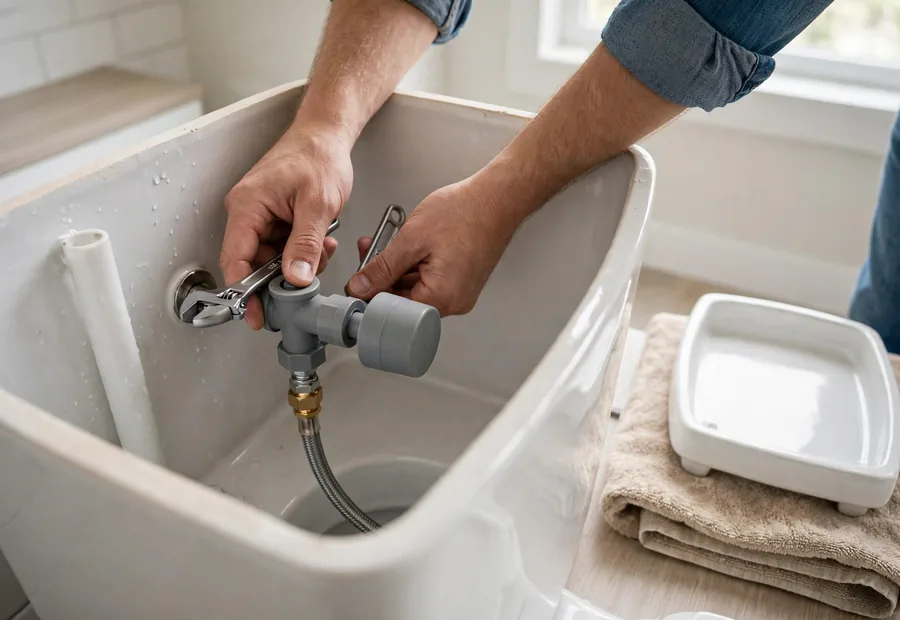
Why a new flapper or valve can start it
It is genuinely common for the banging to begin the week a toilet was repaired, and the connection is not a coincidence or a botched job. Old parts leak and creep: a worn fill valve refills slowly, a tired flapper shortens every cycle. Slow water stops softly. Fit fresh parts and the system returns to full speed — full-speed water, stopped by a healthy fast-closing valve, hammers. The repair restored the flow; the flow exposed the pressure.
The other version: the disturbance of working in the tank finishes off a fill valve that was already failing, and its closing action turns erratic — sometimes smooth, sometimes a slam. If the bang follows a repair, do not undo the repair. Note it, run the fixture test in the next section, and treat the bang as its own problem with its own cause.
Check whether other fixtures do it too
This five-minute test decides the whole shape of the fix:
- Run a cold tap at full flow for ten seconds, then shut it off quickly. Any bang?
- Start the washing machine filling, or listen when it stops mid-cycle. Any bang?
- Flush the other toilet, if there is one, and listen at its shut-off.
Only this toilet bangs: the cause is local — this fill valve's closing action against this home's pressure, possibly worsened by a loose pipe run nearby. Several fixtures bang: the cause is the home's pressure or a shared pipe section, and no amount of toilet work will end it; the pressure needs measuring and dealing with at the source. Either way, write down which fixtures bang before you call anyone — it is the most useful sentence you can say on the phone.
Can it damage the pipes?
Yes — slowly, and at the weakest points. Each spike is small, but a toilet can refill a dozen times a day, and the spikes flex soldered and threaded joints, work on the supply line connection at the tank, and stress the valves and flexible hoses of washing machines and dishwashers connected to the same system. The typical failure, months or years in, is not a burst pipe in the wall; it is a weeping joint, a supply line that lets go at its fitting, or another appliance valve failing early. Our page on supply line and shut-off valve replacement covers the toilet's own connection, which is one of the places hammer shows its wear first. A mild, occasional knock is a nuisance to schedule; a bang you can feel through the floor is wear happening on a timetable.
What actually fixes it
A fill valve that closes more gently. Valves differ in closing action; where the valve itself is the trigger, replacing it with a slower-closing pattern — part of our fill and flush valve service — can end the bang at the source.
A water hammer arrester. A small sealed chamber with a cushion of air (or a piston) fitted near the valve absorbs the spike the way a cushion absorbs a punch. Arresters exist precisely for this problem and are a standard, permanent fix at a single fixture.
Pressure correction. If the gauge shows the home's standing pressure is high, the fix belongs at the pressure-reducing valve — adjustment or replacement — and it protects every fixture in the home, not just the toilet. This is the fix that matters when several fixtures bang.
Securing loose pipe. Where a pipe run has come loose in the wall or under the floor, the spike makes it knock against framing. Re-securing the run silences the knock; it does not reduce the spike, so it is paired with one of the fixes above rather than standing in for them.
What does not fix it: turning the toilet's shut-off valve half-closed to slow the refill. That trades the bang for a permanently lazy refill, stresses the valve washer, and leaves the pressure spike loose in the rest of the system. It is the one home remedy for hammer that plumbers consistently ask people to stop doing.
When to arrange help promptly
Move faster if the bang is new and strong, if it is getting louder over weeks, if pipes visibly move when it happens, or if any joint or supply connection has started to weep — a leak at a hammered joint is the spike finding its exit. Also move faster if several fixtures bang: that is a whole-house pressure reading asking to be taken. A specialist can measure pressure at a hose bib in minutes, test the toilet's valve, and tell you which of the four fixes your home actually needs — in that order, rather than selling you the largest one first. During open hours, call (714) 410-0362 and mention which fixtures bang; it puts the right tools on the truck.
What a pressure reading tells you
Pressure is measured with a gauge screwed onto a hose bib or a washing-machine tap, with no water running anywhere in the home. The reading is the home's standing pressure, and it sorts the problem immediately. Most homes sit comfortably somewhere in the middle range; sustained pressure at the top of or beyond the range household fixtures are built for — plumbing codes generally call for a pressure-reducing valve once pressure passes roughly 80 psi — explains not just banging but the early failure of valves, seals and appliance hoses all over the house.
If the reading is moderate and only the toilet bangs, the spike is being made locally, by that valve closing against ordinary pressure, and the local fixes — valve, arrester — are the right scale of answer. If the reading is high, a local fix would quiet one toilet while the pressure keeps working on everything else. That is why the gauge comes out before parts are discussed: two minutes of measurement decides whether you are fixing a toilet or protecting a house.
Questions about a toilet that bangs after refilling
Is a banging toilet dangerous?
The noise itself is not, but what makes it can be. Each bang is a pressure spike travelling through the pipes, and repeated spikes loosen joints, stress supply line fittings and shorten the life of valves and appliance hoses elsewhere in the home. A bang that is new, getting louder, or strong enough to shake the pipework deserves attention soon rather than eventually — not because the toilet will explode, but because the cumulative wear is real and the eventual failure is usually a leak.
Why did the banging start right after I changed the flapper?
Because the new part changed how fast the water moves. A worn flapper or a tired fill valve often refills slowly, and slow water stops gently. Fit a fresh part and the refill runs at full speed again — then the fill valve snaps shut at the end, and full-speed water stopping dead is exactly what water hammer is. The repair did not break anything; it restored the flow that reveals pressure the old, slower parts had been hiding. Sometimes the disturbance of the work also shifts a fill valve that was already near the end of its life.
Will water hammer go away on its own?
Almost never. The causes — high incoming pressure, a fast-closing valve, a waterlogged or missing air cushion — do not correct themselves, and the noise typically stays the same or slowly worsens as parts wear. The one exception is a bang that appears for a day or two after plumbing work elsewhere in the home, when air has been introduced into the lines; that usually clears as the air works its way out. A bang that has been present for weeks has a cause, and the cause is staying.
Is the banging coming from the toilet or from the house plumbing?
Test it. If the bang happens only with this one toilet and only at the end of its refill, the toilet's fill valve and the pressure feeding it are the story. If taps, the washing machine or another toilet produce a bang when they shut off too, the house pressure or a shared section of pipe is the story, and fixing one toilet will not end it. Note which fixtures bang and tell whoever you call — that single observation separates a one-valve job from a pressure job.
Can high water pressure damage my toilet?
Yes, gradually. Pressure above what household fixtures are built for wears fill valve seals, makes flappers and washers fail early, stresses the supply line connection at the base of the tank, and can make a toilet run intermittently as valves fail to close cleanly against it. If parts in your home seem to wear out faster than they should — in more than one fixture — pressure is worth having measured. It takes minutes with a gauge, and it explains a pattern that part-swapping never fixes.